What Are Diatonic Chords?
Confused by music theory? Discover the 'Crayon Box' analogy for Diatonic Chords and learn why they are the secret safety net for writing perfect Trance melodies in Logic Pro.

More about me Becoming a Trance producer is my aspiration, and I use Logic Pro as my DAW.
What is a Diatonic Chord?
In music theory, “Diatonic” simply means “belonging to the scale.”
When you pick a musical key (like C Major), you are choosing a specific team of notes. Diatonic chords are chords built using only the players on that team. No outsiders allowed!
The Analogy: The “Crayon Box”
Imagine you buy a specific box of crayons labeled “Ocean Colors.” Inside, there are only different shades of Blue and Green.
- The Scale (The Key): This is the box itself. It defines which colors are allowed.
- Diatonic Chords: These are drawings you make using only the crayons in that box. Even though the shades are different, they all look like they belong together.
- Non-Diatonic: If you suddenly grabbed a Hot Pink crayon and scribbled on your ocean drawing, that would be a “non-diatonic” note. It stands out and feels surprising.
I used an AI tool to visualize this crayon analogy. 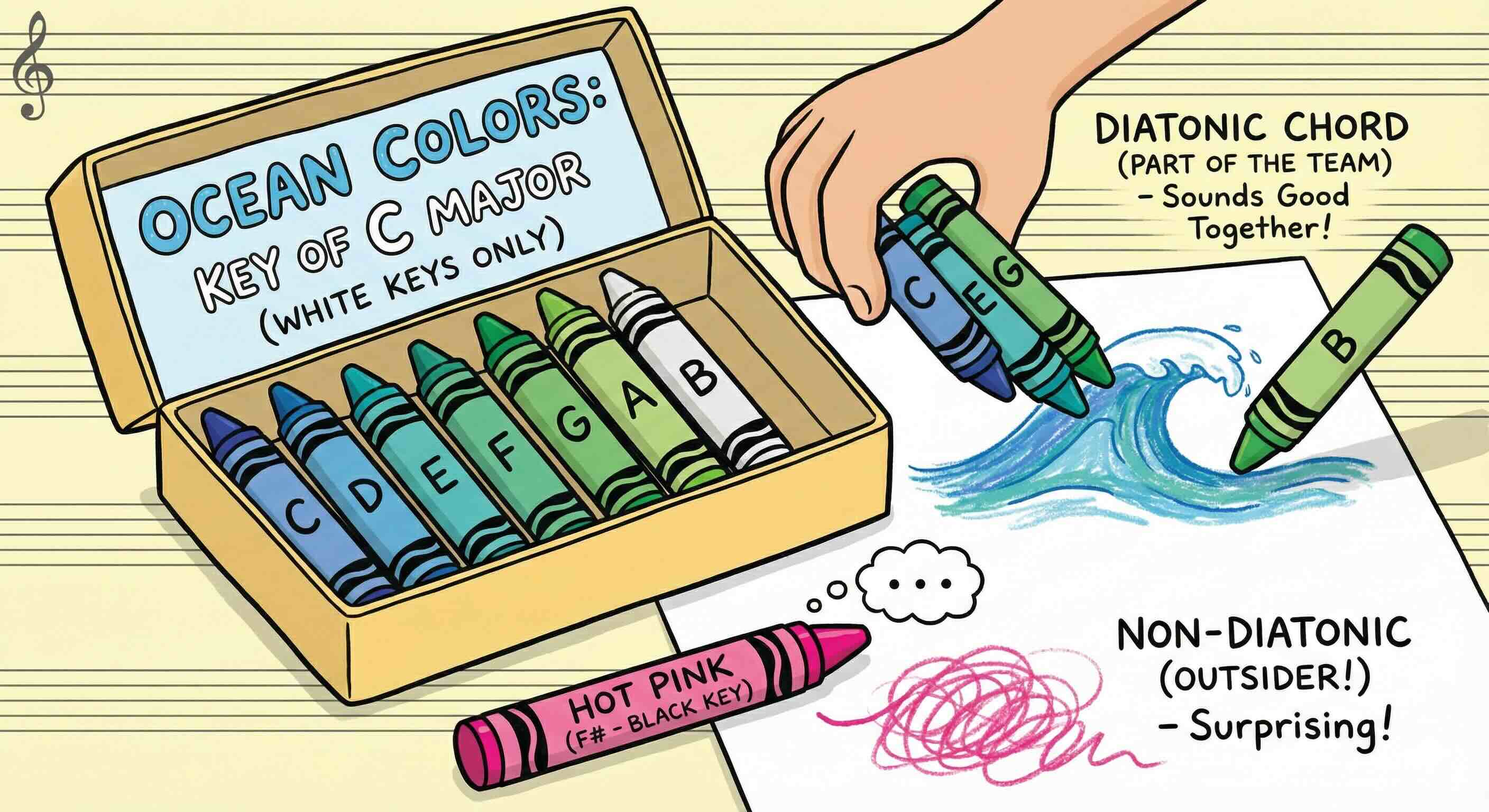
Why Should a Trance Producer Care?
- The “Euphoria” Safety Net: Trance is built on rolling basslines and supersaw leads. Because the sonic spectrum is so full in Trance, clashing notes are amplified.
- Writing Melodies becomes Cheating: If you know your chords are diatonic, you know exactly which notes you can use for your melody. You stop guessing and start writing.
Takeaways
- Definition: Diatonic chords use only the notes from the current key.
- The Benefit: They provide a “safe” harmonic foundation, essential for the dense layering in Trance music.
- The Tool: Use Logic Pro’s Scale Quantize or Chord Trigger to lock yourself into a key and explore diatonic progressions instantly.
If you’re interested, here is a practice:
- Open Logic Pro.
- Load a synthesizer (try Retro Synth).
- Add the MIDI FX “Chord Trigger” before the synth.
- Select the preset “Single > Major Scale Chords”.
Play the white keys. You are now playing strictly Diatonic chords. Do they sound good?