SOLID Principle Brochure
SOLID principle helps us write better code.

This brochure consolidates everything I need to know about the SOLID principle.
Single Responsibility
“A class should have one, and only one, reason to change.”
This doesn’t mean a class should only have one method. It means a class should be responsible for only one part of the system’s functionality.
If I have to change a class because of a Database change, AND I have to change the same class because of a Business Logic change, that class has too many responsibilities.
The Analogy: The Swiss Army Knife

- The Violation: A Swiss Army Knife tries to be a knife, a spoon, a saw, a corkscrew, and a toothpick. It does everything, but it does nothing great. If the corkscrew mechanism jams, the whole knife might become useless. It is heavy, clunky, and hard to clean.
- The Ideal: A dedicated Chef’s Knife. It has one job: cutting. It does it perfectly. If I need to open a wine bottle, I get a corkscrew. If I want to fix the database (or a loose screw), I get a screwdriver. Each tool changes independently.
Examples
Bad Example (The “God” Class)
Meet the User class. It manages state, talks to the database, and even sends emails.
1
2
3
4
5
6
7
8
9
10
11
12
13
14
15
16
17
18
class User {
  private String username;

  // Responsibility 1: Data Management
  public String getUsername() { return username; }

  // Responsibility 2: Database Operations
  public void saveToDatabase() {
    Connection conn = database.getConnection();
    // ... SQL logic ...
  }

  // Responsibility 3: Notification Logic
  public void sendWelcomeEmail() {
    EmailClient client = new EmailClient();
    client.send(this.email, "Welcome!");
  }
}
The Problem:
If the CTO changes the Database from MySQL to PostgreSQL, I touch this class.
If Marketing wants to change the email subject line, I touch the same class.
Shared State: If the class uses shared variables (like a global
dbConnection), a bug in the email logic might leave that connection in a bad state, causing the Login logic to fail subsequently.
Good Example (Delegation)
We split the responsibilities into focused classes.
1
2
3
4
5
6
7
8
9
10
11
12
13
14
15
16
17
18
19
// 1. The Entity (Data only)
class User {
  private String username;
  public String getUsername() { return username; }
}

// 2. The Repository (Database only)
class UserRepository {
  public void save(User user) {
    // ... Database logic ...
  }
}

// 3. The Service (Notification only)
class EmailService {
  public void sendWelcomeEmail(User user) {
    // ... Email logic ...
  }
}
Watch out for these smells
The “And” Keyword: If I describe what a class does and I use the word “and” multiple times (e.g., “This class parses the file AND validates the data AND saves it”), it likely breaks SRP.
God Classes: Classes named
UserManager,SystemHandler, orCentralControllerare often dumping grounds for unrelated logic.Imports from Everywhere: If a class imports
java.sql.*(Database) ANDjava.net.*(Network) ANDjavax.swing.*(UI), it is definitely doing too much.
Why this principle?
Lower Coupling: Changes in the database layer won’t break my email logic.
Fewer Merge Conflicts: The backend engineer works on
UserRepositorywhile the frontend engineer updatesEmailService. They don’t fight over the same file.Reusability: I can use that
EmailServicefor other things (like “Forgot Password”) without dragging along the entire User Database logic.
Open/Closed
“Software entities (classes, modules, functions, etc.) should be open for extension, but closed for modification.”
- Open for extension: Can add new behaviors or functionality to the system.
- Closed for Modification: Should not change the existing source code to add that new functionality.
The Analogy: The Power Strip
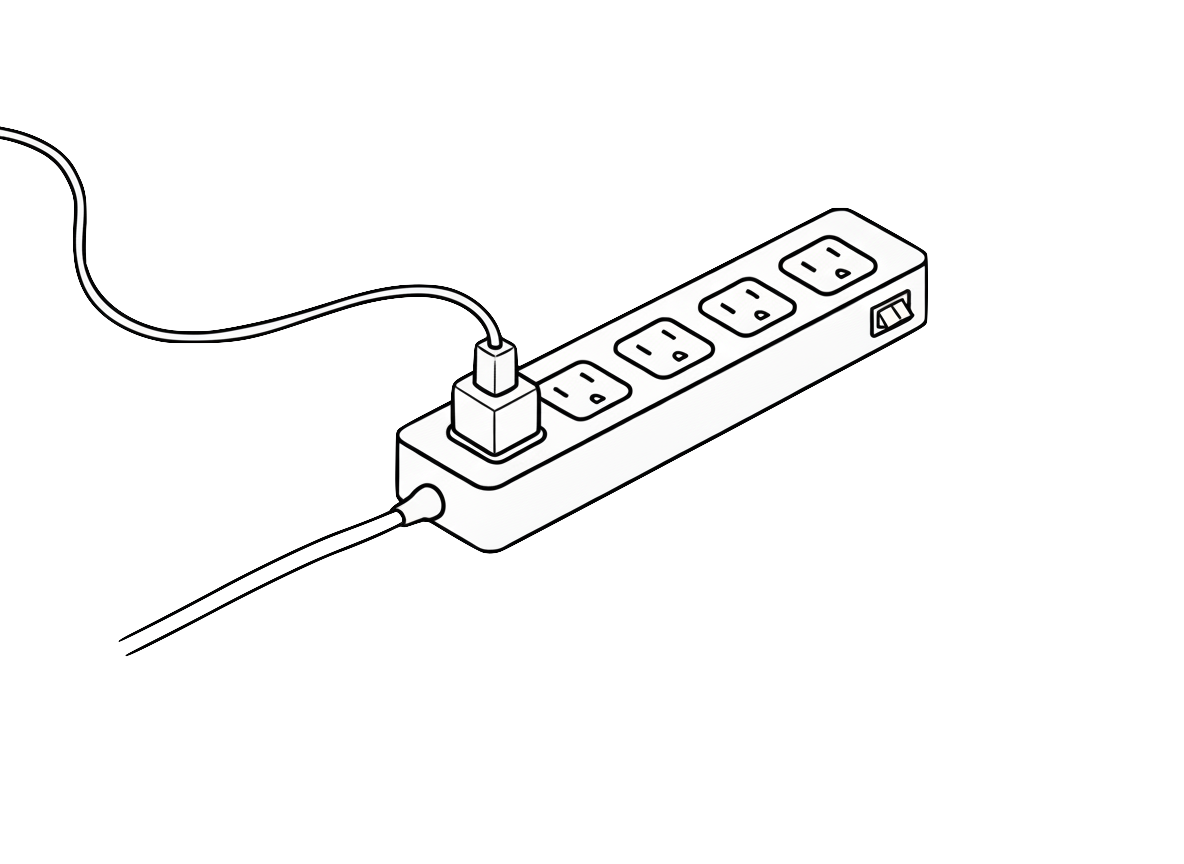
- Closed for Modification: The internal wiring of that strip is set for good. I don’t cut the rubber cord and splice in new wires every time I need to use an appliance. It would be hilarious if I did so, right?
- Open for Extension: The strip provides a standard interface (the socket). I can plug in a lamp, a laptop, or a heater. The power strip doesn’t care what is plugged in, as long as it fits the plug interface. I extend the utility of the electricity without rewiring the internals. Huh, how clever.
Examples
Bad Example
1
2
3
4
5
6
7
8
9
10
11
12
13
class PaymentProcessor {
  public void processPayment(String type, double amount) {
    if (type.equals("CreditCard")) {
      // Logic for verifying credit card
      // Logic for charging credit card
      System.out.println("Paid " + amount + " via Credit Card");
    } else if (type.equals("PayPal")) {
      // Logic for logging into PayPal
      // Logic for sending funds
      System.out.println("Paid " + amount + " via PayPal");
    }
  }
}
Good Example
1
2
3
4
5
6
7
8
9
10
11
12
13
14
15
16
17
18
19
20
21
22
23
24
25
26
27
// Step 1: Create an Interface
interface PaymentMethod {
  void pay(double amount);
}

// Step 2: Create separate classes for each method. These are my "extensions."
class CreditCard implements PaymentMethod {
  public void pay(final double amount) {
    // Logic specific to Credit Cards
    System.out.println("Paid " + amount + " via Credit Card");
  }
}

class PayPal implements PaymentMethod {
  public void pay(final double amount) {
    // Logic specific to PayPal
    System.out.println("Paid " + amount + " via PayPal");
  }
}

// Step 3: The Processor (Closed for Modification)
class PaymentProcessor {
  public void processPayment(final PaymentMethod method, final double amount) {
    // I just call .pay() - I don't care what the specific class is.
    method.pay(amount);
  }
}
Watch out for these smells
- A massive chain of
if (type == X) ... else if (type == Y)like we saw in the bad example. - I have to add a new
casestatement for theswitch. - A hardcoded dependency, like
new PDFReportGenerator()directly inside the logic class, I should create theReportGeneratorinterface and use Dependency Injection to inject the interface instead.- I can put it in another way: Hardcoded dependencies that force me to modify the parent class just to switch tools ( e.g., swapping
PDFGeneratorforExcelGenerator).
- I can put it in another way: Hardcoded dependencies that force me to modify the parent class just to switch tools ( e.g., swapping
Why this principle?
- Testing: When I add
CryptoPayment, I only write tests for that new class. I don’t need to re-test theCreditCardlogic because I didn’t touch it like, at all. - Safety (including mental safety, that’s a huge plus, right?): I can’t break existing features if I don’t even open their files.
- Collaboration: Two developers can write two different payment methods at the same time without merge conflicts in the
PaymentProcessor.
Liskov Substitution
“Subtypes must be substitutable for their base types without altering the correctness of the program.”
Let me put it in a very simple way. If I have a parent class Parent and a child class Child, I should be able to replace Parent with Child everywhere in my code, and nothing should explode.
The Analogy: The Mechanical Duck
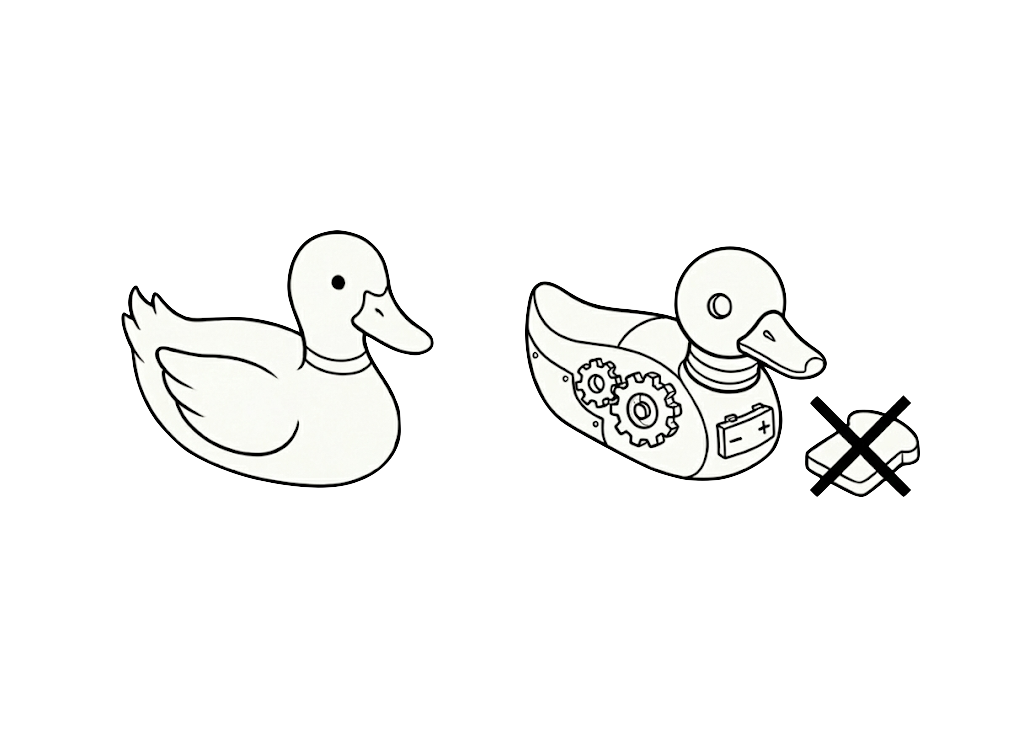
If it looks like a duck, swims like a duck, and quacks like a duck, but it needs batteries to function, we have a problem.
Imagine I have a pond simulator. It holds a collection of Duck objects.
- Real Duck: Eats bread, swims, quacks.
- Mechanical Duck: Eats… batteries? Breaks if put in water?
If my code treats them both as generic Ducks, and I try to feed the Mechanical Duck a piece of bread, it might jam the gears and crash the system. The Mechanical Duck violates the Liskov Substitution Principle because it cannot seamlessly replace a Real Duck, even though they share the same name.
Examples
Bad Example (The Violation)
I create a Bird class with a fly() method. Everyone loves birds. Then I add a Penguin. Penguins are birds, right? So Penguin extends Bird.
1
2
3
4
5
6
7
8
9
10
11
12
13
14
15
16
17
18
19
20
21
22
23
24
25
26
class Bird {
    public void fly() {
        System.out.println("I believe I can fly...");
    }
}

class Sparrow extends Bird {
    // Inherits fly() - Works great.
}

class Penguin extends Bird {
    @Override
    public void fly() {
        // ERROR: Penguins can't fly!
        throw new UnsupportedOperationException("I can't fly!");
    }
}

// The Client Code
public void moveBirds(List<Bird> birds) {
    for (Bird bird : birds) {
        // If I pass a Penguin here, my program CRASHES.
        // This means Penguin is NOT a safe substitute for Bird.
        bird.fly();
    }
}
Good Example (The Fix)
The problem isn’t the Penguin; the problem is my abstraction. Not all birds fly. I should separate the capabilities (Interfaces) from the biology.
1
2
3
4
5
6
7
8
9
10
11
12
13
14
15
16
17
18
19
20
21
22
23
24
25
26
27
28
// Capability 1: Moving
interface Moveable {
    void move();
}

// Capability 2: Flying (Only for flying birds)
interface Flyable {
    void fly();
}

class Sparrow implements Moveable, Flyable {
    public void move() { System.out.println("Hopping..."); }
    public void fly() { System.out.println("Flying high!"); }
}

class Penguin implements Moveable {
    // Penguin only implements Moveable, NOT Flyable.
    public void move() { System.out.println("Running fast!"); }
}

// The Client Code
public void moveBirds(List<Moveable> birds) {
    for (Moveable bird : birds) {
        // Safe! Both Sparrow and Penguin can move.
        // I don't need to ask "Are you a Penguin?"
        bird.move();
    }
}
Watch out for these smells
- Refused Bequest: Does my child class override a method just to throw
NotImplementedExceptionor do nothing? That’s a red flag. - Type Checking: Do I see code like
if (item instanceof Penguin)? That usually means my abstraction is leaky. - Downcasting: Am I constantly casting a generic object down to a specific type to get it to work? To fix downcasting, look for the common intent behind the specific actions. If a
Penguinslides and aSparrowflies, the common intent is movement. Create a genericmove()method and let each class handle its own implementation details.- Why it is dangerous: If I add a new bird (e.g.,
Ostrich), I have to hunt down every singleif (instanceof ...)statement in my entire codebase and update it. If I miss one, I get a runtime crash. That is the opposite of “Closed for Modification.” - How to fix it: Generalize the Action
- Identify the Intent: Why am I checking if it’s a
Penguin? I want it to move. - Rename the Method:
fly()is too specific.slideOnBelly()is too specific. Change the parent method tomove()orperformAction(). - Push the Logic Down: Move the “how” into the specific classes. Implement the
move()method inPenguin, and actually make itslideOnBelly()
- Identify the Intent: Why am I checking if it’s a
- Note: Sometimes I can’t generalize. For example,
playMusic()vslayEgg(). They aren’t the same “type” of action. If I find myself downcasting in that situation, it usually means my list is too generic. I should split theList<Object> things(containsDuck,Radio,Car) intoList<Animal> animalsandList<Device> devices.
- Why it is dangerous: If I add a new bird (e.g.,
1
2
3
4
5
6
7
8
9
10
// The "Smell" of Downcasting
for (Bird bird : birds) {
    if (bird instanceof Penguin) {
        // I have to cast it (Downcast) to make it do what I want.
        // This implies 'Bird' is a leaky abstraction.
        ((Penguin) bird).slideOnBelly();
    } else {
        bird.fly();
    }
}
Why this principle?
- No Surprises: A
List<Bird>should behave like a list of birds. I shouldn’t have to worry about one of them being a grenade (or a Penguin). - Maintainability: I can add new “Good” birds forever without breaking the
moveBirdsmethod. - Safety: In a No QA environment, LSP is critical. If I create a subclass that throws unexpected errors, no QA tester will catch it. It will crash in production when a user triggers that specific edge case.
Interface Segregation
“Clients should not be forced to depend upon interfaces that they do not use.”
Please let me interpret it in simpler terms: Don’t force a class to sign a contract it can’t fulfill. If I have a massive interface (a “Fat” interface), and a class only needs one small part of it, I shouldn’t force that class to implement the rest just to make the compiler happy.
The Analogy: The Universal Remote vs. The Dedicated Button

The Violation: Imagine a TV remote that also has buttons to control the Microwave, the Garage Door, and the AC. If I just want to change the channel, I still have to hold this massive, heavy brick. Worse, if the “Microwave” button shorts out, I might have to replace the whole remote, even though the TV part works fine.
The Ideal: Small, focused controls. I have a TV remote for the TV. I have a wall switch for the Garage. If I am a “TV Watcher,” I don’t need to carry the “Garage Opener” dependency.
Examples
Bad Example (The “Fat” Interface)
I have a Worker interface. It seems logical: workers work, and they need to take breaks to eat.
1
2
3
4
5
6
7
8
9
10
11
12
13
14
15
16
17
18
19
interface Worker {
    void work();
    void eat();
}

class HumanWorker implements Worker {
    public void work() { System.out.println("Working..."); }
    public void eat() { System.out.println("Eating lunch..."); }
}

class RobotWorker implements Worker {
    public void work() { System.out.println("Beep boop, working..."); }

    // PROBLEM: Robots don't eat!
    // I am forced to implement this method just to satisfy the interface.
    public void eat() {
        throw new UnsupportedOperationException("I don't eat!");
    }
}
The Issue: The RobotWorker depends on eat(), even though it doesn’t use it. If the definition of eat() changes (e.g., requires calories parameter), I have to update the Robot class, which is absurd.
Good Example (Segregated Interfaces)
I split the “Fat” interface into smaller, capability-based interfaces (Role Interfaces).
1
2
3
4
5
6
7
8
9
10
11
12
13
14
15
16
17
18
19
20
21
// Capability 1: Working
interface Workable {
    void work();
}

// Capability 2: Eating
interface Feedable {
    void eat();
}

// Human needs both
class HumanWorker implements Workable, Feedable {
    public void work() { System.out.println("Working..."); }
    public void eat() { System.out.println("Eating lunch..."); }
}

// Robot only needs one
class RobotWorker implements Workable {
    public void work() { System.out.println("Beep boop, working..."); }
    // No eat() method here. Clean.
}
Watch out for these smells
“Not Implemented” Exceptions: If I see a class override a method just to throw
new UnsupportedOperationException(), it’s a screaming sign of an ISP violation.Empty Methods: Implementing a method with an empty body
{ }just to satisfy the compiler.Fat Interfaces: Interfaces with names like
Service,Manager, orUtilthat have 20+ unrelated methods.
Why this principle?
Leaner Mocks: When I write unit tests, I don’t want to mock 50 methods for a “God Interface” when I only test one behavior. Segregated interfaces make testing trivial.
Safety: I can’t accidentally call
robot.eat()and crash the system at runtime, because the method simply doesn’t exist on the API level.Decoupling: Changes to the “Eating” logic never touch the “Robot” file.
Dependency Inversion
“High-level modules should not depend on low-level modules. Both should depend on abstractions.”
Let’s translate that into English: Don’t solder the lamp directly to the electrical wiring.
If I build a house and I wire the lamp directly into the wall, I can never move it. I can never replace it with a fan. I am stuck. Instead, I install a Socket (Interface). The lamp depends on the socket. The electrical wiring depends on the socket. Now, I can plug anything in.
The Analogy: The Wall Socket
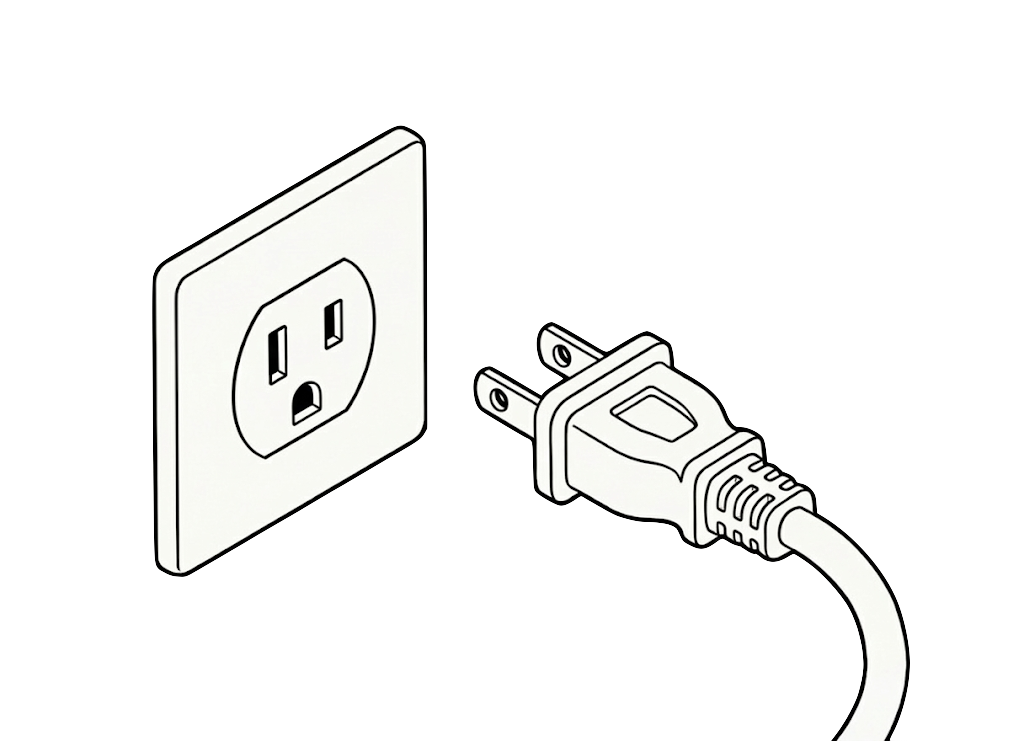
- The Violation (Soldering): Imagine if my laptop charger was permanently welded to the nuclear power plant. If the plant goes down, I can’t just switch to solar. If I want to move to a coffee shop, I have to drag the power plant with me.
- The Ideal (The Socket): My laptop plug (High Level) doesn’t care if the electricity comes from a Nuclear Plant, a Wind Farm, or a Hamster Wheel (Low Level). It only cares that it fits the Standard 2-Prong Socket (Abstraction).
Examples
Bad Example (Hard Dependencies)
I have a NotificationService (High Level) that needs to send messages. I hardcode the EmailSender (Low Level) inside it.
1
2
3
4
5
6
7
8
9
10
11
12
13
14
15
16
17
18
19
class EmailSender {
    public void sendEmail(String msg) {
        System.out.println("Sending email: " + msg);
    }
}

class NotificationService {
    private EmailSender sender;

    public NotificationService() {
        // ERROR: I am creating the dependency myself ("New is Glue").
        // I am now stuck with EmailSender forever.
        this.sender = new EmailSender();
    }

    public void promote() {
        sender.sendEmail("50% OFF!");
    }
}
The Problem: If I want to change from Email to SMS, I have to rewrite the NotificationService. I have violated the Open/Closed principle because my high-level logic depends on the low-level detail of “Email.”
Good Example (Dependency Injection)
I flip the dependency. I ask for an interface in the constructor.
1
2
3
4
5
6
7
8
9
10
11
12
13
14
15
16
17
18
19
20
21
22
23
24
25
26
27
28
// 1. The Abstraction (The Socket)
interface MessageSender {
    void sendMessage(String msg);
}

// 2. The Low-Level Modules (The Plugs)
class EmailSender implements MessageSender {
    public void sendMessage(String msg) { System.out.println("Email: " + msg); }
}

class SmsSender implements MessageSender {
    public void sendMessage(String msg) { System.out.println("SMS: " + msg); }
}

// 3. The High-Level Module
class NotificationService {
    private MessageSender sender;

    // "Inject" the dependency.
    // I don't care if it's Email or SMS, as long as it fits the interface.
    public NotificationService(MessageSender sender) {
        this.sender = sender;
    }

    public void promote() {
        sender.sendMessage("50% OFF!");
    }
}
Watch out for these smells
“New is Glue”: If I see
new ConcreteClass()inside a high-level business logic class, I am coupling them together.Static Calls: Static methods like
Database.save()are global and permanent. I cannot replace them with a mock object during testing, which forces my test suite to depend on a real, slow, and fragile database connection.
Why this principle?
Swappability: I can switch from
MySQLtoPostgreSQLwithout changing a single line of my business logic.Testing: This is the #1 reason we do this. If I hardcode
EmailSender, my unit tests will spam real emails. If I use Dependency Inversion, I can inject aFakeSenderthat just logs “Email sent” to the console during tests.
1
2
// Testing is easy now!
NotificationService testService = new NotificationService(new FakeSender());
💡 LSP vs. ISP: Wait, aren’t they the same?
You might have noticed that the Bad Examples for Liskov Substitution (Penguin) and Interface Segregation (Robot) look almost identical. In both cases, the class throws an error because it can’t do what it’s asked to do.
| Principle | Perspective | The Complaint |
|---|---|---|
| Liskov (LSP) | The User (Client) | “I asked for a Bird, you gave me a Penguin, and now my code crashed because I tried to fly it. You broke my trust!” |
| Segregation (ISP) | The Class (Implementer) | “I am a Robot. Why do I have to import the ‘Food’ library and compile ‘Nutrition’ modules just to implement the ‘Worker’ interface? This is unnecessary baggage.” |
The Relationship: Often, ISP is the tool used to fix an LSP violation. If a Penguin cannot replace a Bird (LSP Violation), it is likely because the Bird interface is too “fat” and includes flying logic by default. By breaking Bird into Flyable and Walkable (applying ISP), you solve the substitution problem.
The Takeaway
- At the end of the day, “SOLID” is a tool, not a religion.
- “SOLID” helps us ship faster in the long run.