LeetCode Journey: Digest LeetCode 75
A digestible journey through the LeetCode 75 Study Plan. This post dives into the Two-Pointers pattern, exploring intuitive solutions and visual analogies for problems like 'Max Number of K-Sum Pairs' (1679) and '3Sum' (15).

This is an evolving blog documenting how I approached the problems in LeetCode 75 Study Plan.
📚 Here’s my code repo: https://github.com/b0yu-li/lc2026
[Category] Two-Pointers
No.1679 - Max Number of K-Sum Pair
Description
Pro Tip: You can skip the description portion if you already know the problem.
You are given an integer array nums and an integer k.
In one operation, you can pick two numbers from the array whose sum equals k and remove them from the array.
Return the maximum number of operations you can perform on the array.
Example 1:
Input: nums = [1,2,3,4], k = 5
Output: 2
Explanation: Starting with nums = [1,2,3,4]:
- Remove numbers 1 and 4, then nums = [2,3]
- Remove numbers 2 and 3, then nums = [] There are no more pairs that sum up to 5, hence a total of 2 operations.
Example 2:
Input: nums = [3,1,3,4,3], k = 6
Output: 1
Explanation: Starting with nums = [3,1,3,4,3]:
- Remove the first two 3’s, then nums = [1,4,3] There are no more pairs that sum up to 6, hence a total of 1 operation.
Constraints:
1 <= nums.length <= 10^51 <= nums[i] <= 10^91 <= k <= 10^9
How I Approach It (Solution #1 - The Waiting Room Analogy)
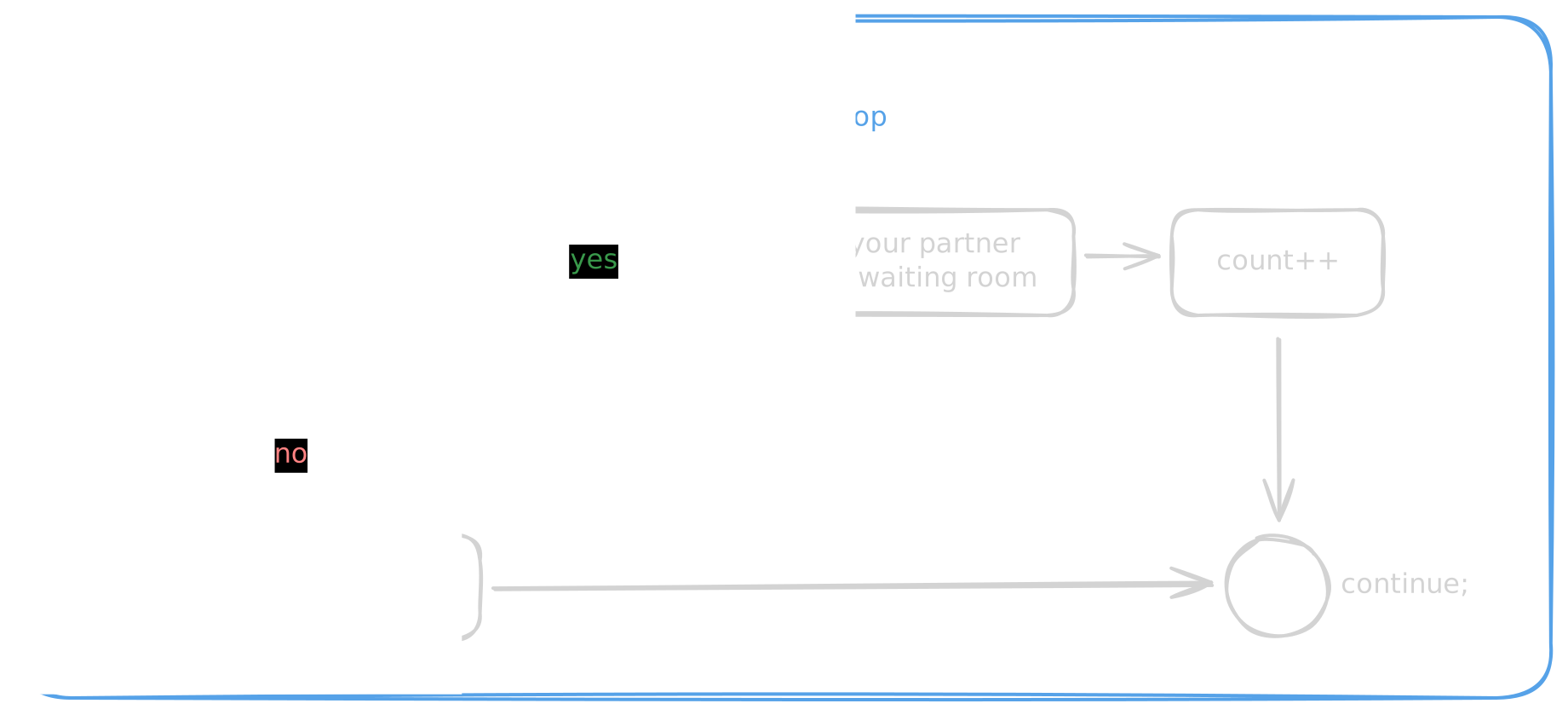
- Imagine I am the bouncer at the door of a club.
- People (
nums) arrive one by one. - I have a “Waiting Room” (the
HashMap).
- People (
- And I perform actions like this:
Solution Snippet
1
2
3
4
5
6
7
8
9
10
11
12
13
14
15
16
17
18
public int maxOperations(int[] nums, int k) {
  final Map<Integer, Integer> waitingRoom = new HashMap<>();
  int count = 0;

  for (int currentGuest : nums) {
    final int partner = k - currentGuest;
    final Integer candidatePartnersCount = waitingRoom.getOrDefault(partner, 0);
    if (candidatePartnersCount > 0) {
      waitingRoom.put(partner, candidatePartnersCount - 1);
      count++;
      continue;
    }
    final Integer existingCountOfCurrentGuest = waitingRoom.getOrDefault(currentGuest, 0);
    waitingRoom.put(currentGuest, existingCountOfCurrentGuest + 1);
  }

  return count;
}
Time Complexity Analysis: O(N)
- I iterate through the array exactly once.
- HashMap operations (put, get, containsKey) are O(1) on average.
Space Complexity Analysis: O(N) (worst-case scenario)
- In the worst case (e.g.,
[1, 2, 3, 4]withk=100), no pairs are found, and every single number is stored in the map.
How I Approach It (Solution #2 - The Matchmaker Analogy)
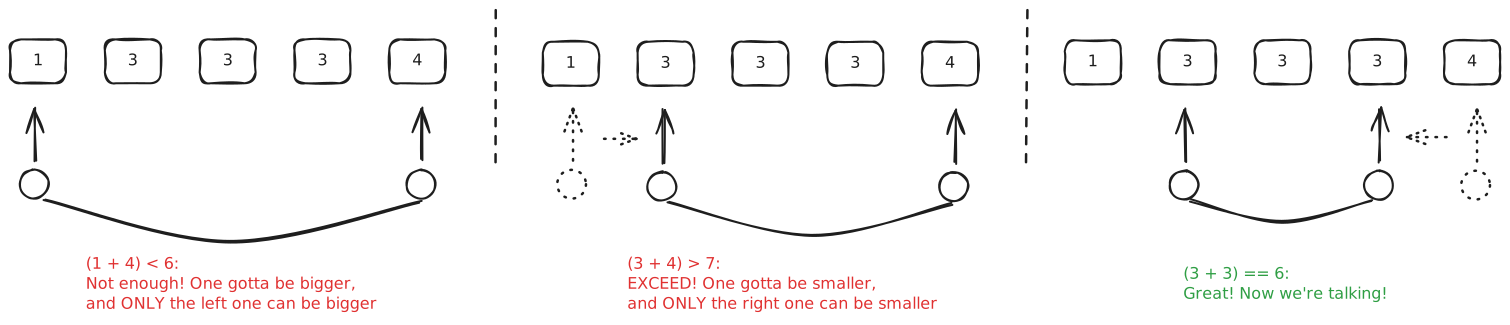
- Say I am a matchmaker trying to pair people up so their combined “score” equals exactly
k. - Since I CANNOT easily spot pairs in a chaotic crowd. So, before I do anything, I yell: “Everyone line up!” (I must sort the array first. This is the cost of admission for this approach.)
- And I pair them up like this.
Solution Snippet
1
2
3
4
5
6
7
8
9
10
11
12
13
14
15
16
17
18
19
20
21
22
23
24
25
26
27
28
29
30
31
public int maxOperations(int[] nums, int k) {
  // Step 0: Line them up smallest to biggest (sorting)
  Arrays.sort(nums);

  int count = 0;
  int left = 0;
  int right = nums.length - 1;

  while (left < right) {
    final int leftCandidate = nums[left];
    final int rightCandidate = nums[right];
    // Case I: Found one pair, congrads! Let both go and count them up!
    if (k == leftCandidate + rightCandidate) {
      count++;
      left++;
      right--;
      continue;
    }
    // Case II: One has to be bigger, only LEFT side can be bigger
    if (k > leftCandidate + rightCandidate) {
      left++;
      continue;
    }
    // Case III: One has to be smaller, only RIGHT side can be smaller
    if (k < leftCandidate + rightCandidate) {
      right--;
    }
  }

  return count;
}
Time Complexity Analysis: O(N * logN)
Sorting:
Arrays.sort(nums)uses Dual-Pivot Quicksort for primitive arrays. This runs in O(N * logN) on average.Two Pointers: The
whileloop performs a single pass through the array, touching each element at most once. This is O(N).Total: The sorting dominates the linear scan, so the final complexity is O(N * logN).
Space Complexity Analysis: O(logN)
- I am sorting in-place.
- There is no new array allocated on the heap.
- Note: We say O(logN) (instead of pure O(1)) to account for the stack space used by the recursive calls inside the Quicksort algorithm.
- In an interview: You can state, “It uses O(1) auxiliary space excluding the recursion stack,” which is often what they are looking for.
No.15 - 3Sum
Description
Pro Tip: You can skip the description portion if you already know the problem.
Given an integer array nums, return all the triplets [nums[i], nums[j], nums[k]] such that i != j, i != k, and j != k, and nums[i] + nums[j] + nums[k] == 0.
Notice that the solution set must not contain duplicate triplets.
Example 1:
Input: nums = [-1,0,1,2,-1,-4]
Output: [[-1,-1,2],[-1,0,1]]
Explanation:
nums[0] + nums[1] + nums[2] = (-1) + 0 + 1 = 0.
nums[1] + nums[2] + nums[4] = 0 + 1 + (-1) = 0.
nums[0] + nums[3] + nums[4] = (-1) + 2 + (-1) = 0.
The distinct triplets are [-1,0,1] and [-1,-1,2]. Notice that the order of the output and the order of the triplets does not matter.
Example 2:
Input: nums = [0,1,1]
Output: []
Explanation: The only possible triplet does not sum up to 0.
Example 3:
Input: nums = [0,0,0]
Output: [[0,0,0]]
Explanation: The only possible triplet sums up to 0.
Constraints:
3 <= nums.length <= 3000-10^5 <= nums[i] <= 10^5
How I approach it (The “Zen Team” Building Analogy)
This problem is actually just an enhanced version of Problem No. 1679 (Max Number of K-Sum Pairs).
The key is to shift the perspective. Previously, we were looking for 2 numbers. Now, we need 3. So naturally, I thought: ‘What if I just pin down one number as my anchor?’ That simple idea is all we need to get started.
The Analogy: The “Zen Team” Building. Imagine I am a manager trying to form perfectly balanced teams of 3 people for a project.
- Negative Numbers (-) are “Pessimists” (drain energy).
- Positive Numbers (+) are “Optimists” (add energy).
- Zero (0) is a “Realist”.
A perfect team sums to exactly Zero. If I pick randomly, it’s chaos. So, I can use a system:
- The Line-Up (
Arrays.sort). First, I line up all candidates in a single row from Most Pessimistic (left) to Most Optimistic (right).
Why? Now I don’t have to guess. If a team is “too negative,” I know exactly where to look for more positivity (to the right).
The Anchor (
for int a ...). I walk down the line and pick the first person, let’s call him Captain A (This isnums[a]).- Say Captain A is a -4 (Pessimist).
- To balance him out, I need the other two members to sum to exactly +4. This is my
target.
The Recruiters (The Two Pointers), please refer to this section.
The “Magic Clipboard” (The
HashSet). If I try to write down a team that is already on the list, the clipboard automatically dissolves the ink. I don’t need to manually check for duplicates; the data structure does the dirty work for me.
Solution Snippet
1
2
3
4
5
6
7
8
9
10
11
12
13
14
15
16
17
18
19
20
21
22
23
24
25
26
27
28
29
30
31
32
33
34
35
36
37
38
39
40
41
42
43
44
45
46
public List<List<Integer>> threeSum(int[] nums) {
  // The "Magic Clipboard" automatically handles duplicates for us
  final Set<List<Integer>> validTeams = new HashSet<>();

  // Step 1: The Line-Up (Sorting)
  Arrays.sort(nums);

  // Step 2: The Captain (Iterate through every possible team leader)
  for (int i = 0; i < nums.length - 2; i++) {

    // The Captain's value (e.g., -4)
    // We need the other two members to sum to exactly +4
    final int target = -nums[i];

    int left = i + 1;            // "Lefty" starts at the next person
    int right = nums.length - 1; // "Righty" starts at the end

    while (left < right) {
      final int currentSum = nums[left] + nums[right];

      // Case I: Perfect Match! (Team Balanced)
      if (currentSum == target) {
        validTeams.add(List.of(nums[i], nums[left], nums[right]));
        left++;
        right--;
        continue;
      }

      // Case II: Too Quiet/Negative? (Sum is too small)
      // Lefty is too negative, so we try the next person
      if (currentSum < target) {
        left++;
        continue;
      }

      // Case III: Too Loud/Positive? (Sum is too big)
      // Righty is too positive, so we try the previous person
      if (currentSum > target) {
        right--;
      }
    }
  }

  return new ArrayList<>(validTeams);
}
Time Complexity Analysis: O(N²)
- Sorting: The initial
Arrays.sortcosts O(N log N). - Two Pointers: The nested loop structure (outer
for+ innerwhile) iterates through the array in O(N²) time. This dominates the sorting cost.
Space Complexity Analysis: O(N) to O(N²) (Dependent on solution size)
- Sorting Stack: O(log N) for the Dual-Pivot Quicksort stack.
- Auxiliary Space: We use a
HashSetto de-duplicate results. In the worst case (many valid triplets), the set size can grow up to O(N²).- The O(N²) comes from the fact that with the right numbers, you can form a “web” of solutions where almost everyone matches with everyone else.
1
2
3
4
5
6
7
Array: [-5, -4, -3, -2, -1, 0, 1, 2, 3, 4, 5]

If a = -5 (Need +5): [-5, 0, 5], [-5, 1, 4], [-5, 2, 3]  (3 solutions)
If a = -4 (Need +4): [-4, -1, 5], [-4, 0, 4], [-4, 1, 3] (3 solutions)
If a = -3 (Need +3): [-3, -2, 5], [-3, -1, 4], ...       (Many solutions)
...
Total Solutions = Sum of all these rows ≈ N²
- Note: A purely iterative solution with manual duplicate skipping would achieve O(1) auxiliary space, but my implementation prioritizes readability.